Standard Operating Procedures on WordPress: Writing SOPs Your Team Actually Follows
What an SOP is, when a wiki page or a course is enough, a one-page template, who owns and reviews it, and how to build an SOP library on WordPress with KnowX.

A standard operating procedure, or SOP, is a short written set of steps for a job your team does again and again. A team follows one when it is written by the people who do the work, kept to the steps that matter, put where the work happens, and reviewed on a fixed date by a named owner. Skip any of those four and the document turns into a file nobody opens.
This guide covers what an SOP is, when a wiki page or a training course is the better tool, a template you can copy, how to review and version SOPs, and where they usually fail. We also show how to build an SOP library on WordPress with KnowX, our free theme, including what it cannot do. We checked the sources on 16 November 2026.
What is a standard operating procedure?
The US Environmental Protection Agency, in its guidance for preparing SOPs (document EPA QA/G-6, April 2007), defines an SOP as a set of written instructions that document a routine or repetitive activity followed by an organization. It adds that other names are fine: protocols, instructions and worksheets all describe the same thing. You can read the source in full: EPA, Guidance for Preparing Standard Operating Procedures.
That definition has two parts worth keeping. “Routine or repetitive” means you do not write an SOP for a one-off project. “Followed by an organization” means the point is that different people do the task the same way.
The EPA wrote for laboratories and government programmes, so some of its advice is heavier than a ten-person shop needs. We use it because it is a primary source with a stated purpose, and because the parts that matter for any team (who writes, how detailed, how often to review) are stated plainly. Where we go beyond it, we say so.
Do you need a formal SOP, a wiki page or a training course?
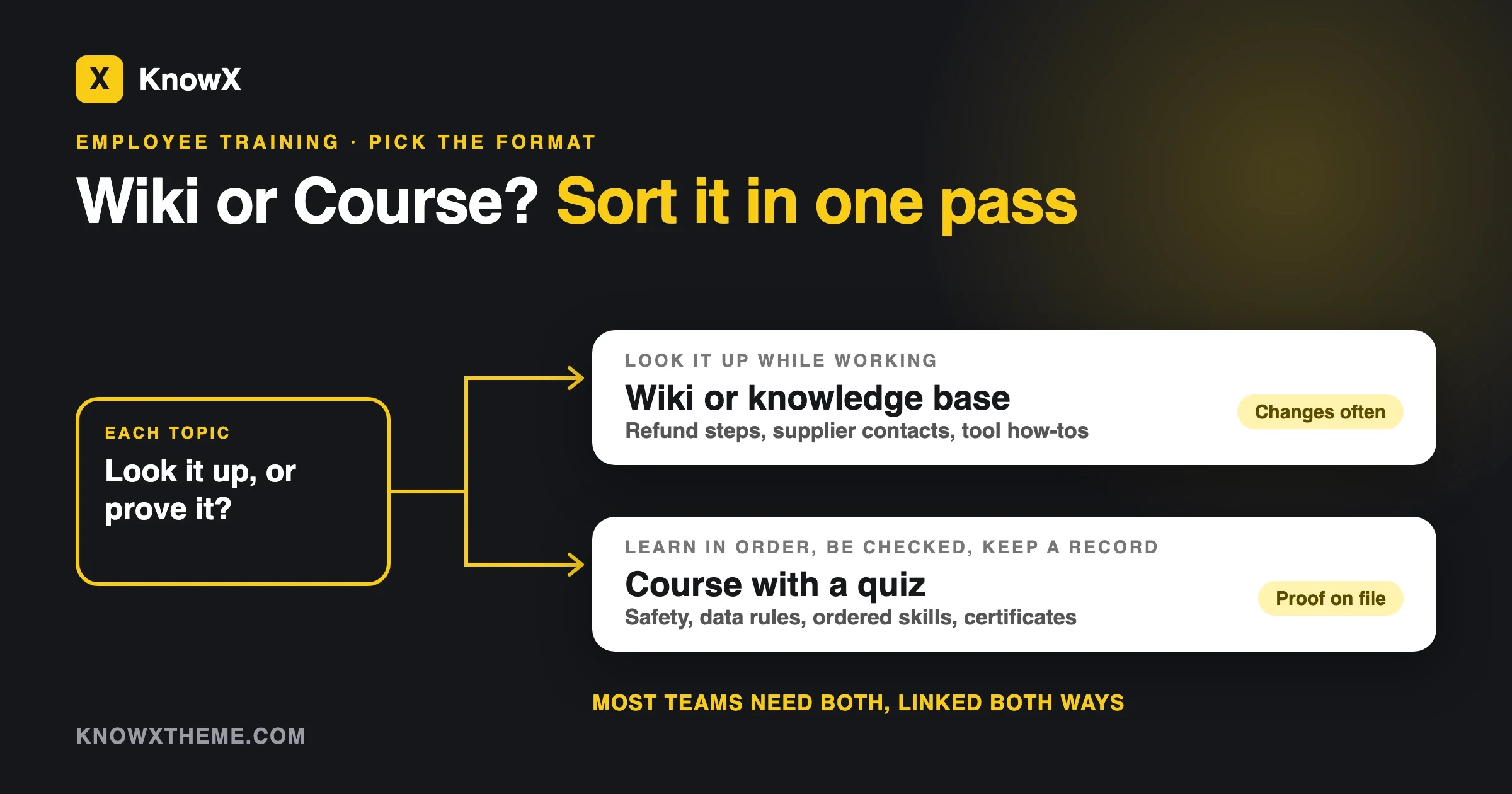
Not every piece of know-how needs an SOP. A rough rule from our own guides: if people look the answer up while they work, a wiki or knowledge base page is enough. If people must learn something in order and prove they know it, that is training. An SOP sits between the two. It is a procedure with a standard way of doing it, an owner, and a review date.
Format | Best for | Who writes it | How you know it works |
|---|---|---|---|
Wiki or knowledge base page | Answers people look up: where the label printer paper is, how to reset a login | Anyone who knows the answer | Searches find it, and nobody asks the question twice |
Formal SOP | A repeated task where doing it differently costs money, time or trust: refunds, month-end close, onboarding a client | The person who does the task, approved by someone responsible for the result | Two people follow it and get the same result |
Training course | Rules people must learn before the job and prove they learned: safety briefings, data-handling rules | Someone who can teach and check | A record that each person finished and passed |
Our guides on choosing a wiki or a course for employee training and on internal wiki versus knowledge base go further on the first and third rows. Many SOPs are best delivered as a mix: a short SOP in the library, plus a training session for the three steps where mistakes are expensive.
Which processes deserve an SOP?
Write an SOP when the answer to at least two of these questions is yes:
- Is the task repeated often, weekly or more?
- Does a mistake cost real money, a customer or a legal problem?
- Do several people do it, or will someone new have to take it over?
- Does the task have steps that are easy to skip?
The EPA guidance gives a similar list for deciding how much detail to write. It says the level of detail depends on whether the process is critical, how often the procedure is followed, how many people will use the SOP and whether training is routinely available. A task done daily by one person who trained for it needs less on paper than a task done twice a year by whoever is free.
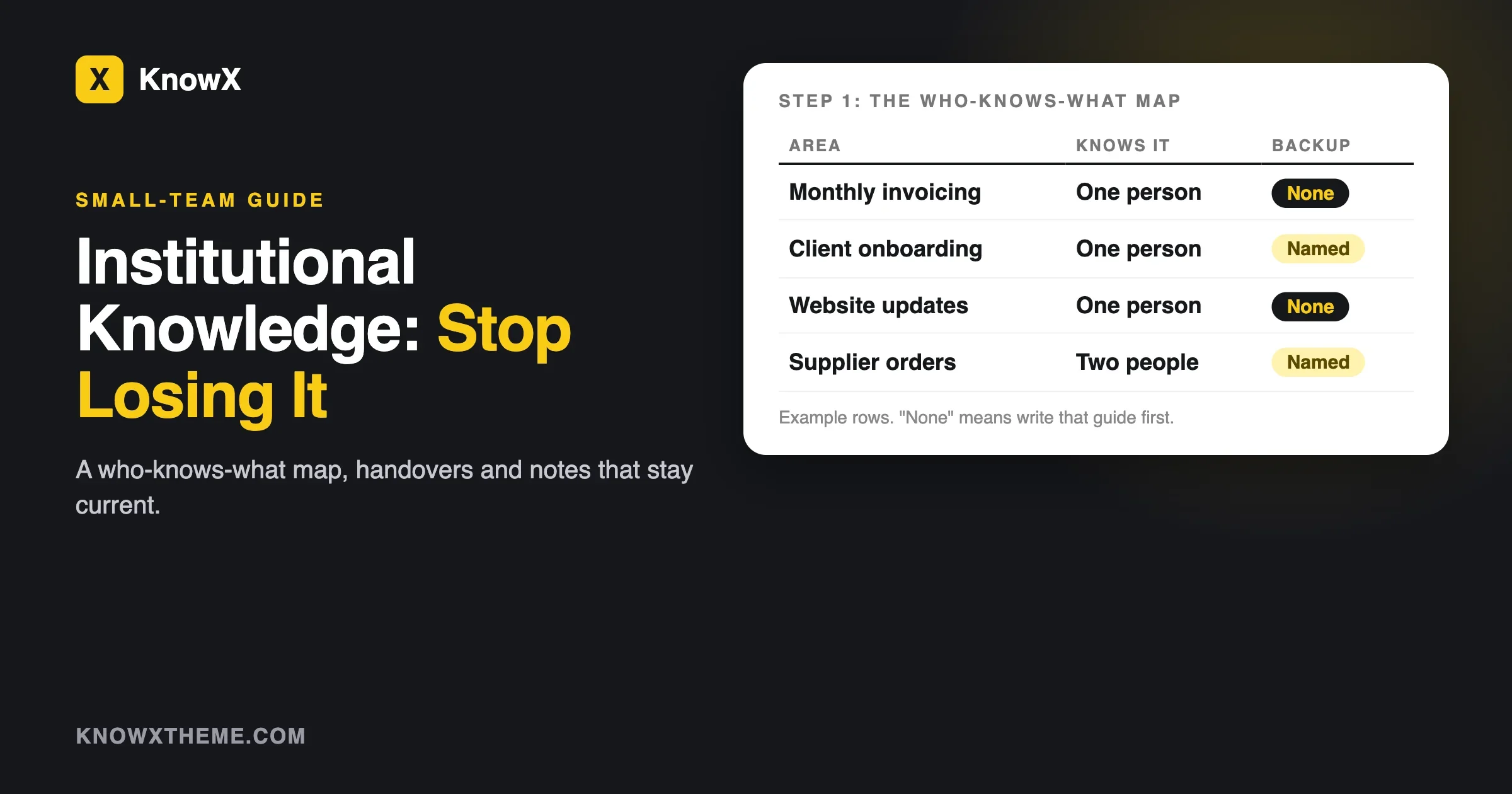
Start with the tasks that fail the “what if they are off sick” test. If nobody else could do the payroll run, the supplier payment or the website update, that is your first SOP. Our guide on how a small team stops losing institutional knowledge covers the wider problem: knowledge that sits in one head and leaves with it.
What should an SOP contain?
The EPA says there is no single correct format, and that internal formatting varies with the organization and the type of SOP. Its general layout is a useful checklist. A title page with a clear title, an SOP identification number, the date of issue or revision, the part of the organization it applies to, and the signatures of those who prepared and approved it. Then the text: purpose, scope, definitions of unusual terms, the procedure in sequence, and any safety points. The guidance also lists personnel qualifications and quality-control checks for technical work.
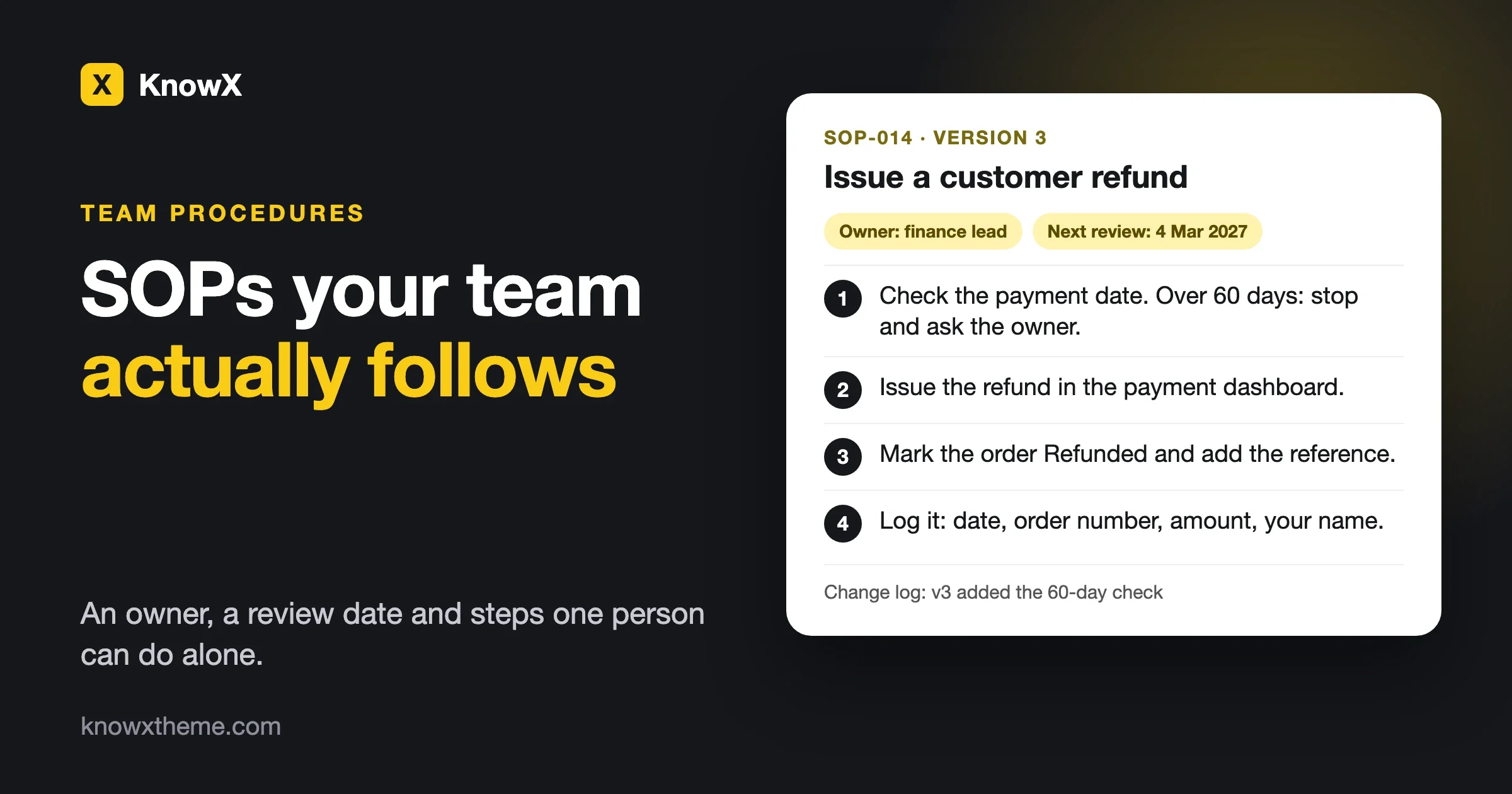
A small team can shrink that to one page. Here is the template we would hand a business with no compliance office. Copy it, and cut any line you do not need.
SOP-014: Issue a customer refund
Owner: Priya (finance lead)     Approved by: Sam (operations)
Version: 3     Issued: 4 March 2026     Next review: 4 March 2027

PURPOSE
Make sure every refund is checked, recorded and paid once.

SCOPE
Covers refunds on orders under 500. Larger refunds go to Sam first.
Does not cover chargebacks (see SOP-021).

BEFORE YOU START
- Access to the payment dashboard and the order system
- The order number and the reason given by the customer

STEPS
1. Open the order and check the payment date. If it is over 60 days ago, stop and ask the owner.
2. Confirm the item or service was not delivered, or is faulty.
3. Issue the refund in the payment dashboard for the amount paid.
4. Mark the order Refunded and add the refund reference as a note.
5. Email the customer using the refund template.
6. Add one line to the refund log: date, order number, amount, your name.

IF SOMETHING GOES WRONG
- Refund fails: do not retry. Message the owner with the order number.
- Customer disputes the amount: send the order link to the owner.

CHANGE LOG
v3, 4 March 2026: added the 60-day check (Priya)
v2, 10 Sept 2025: added the refund log (Priya)
Notice what the template leaves out: background, history and opinions. Those belong in a wiki page that the SOP links to. An SOP answers one question, which is “what do I do next?”
How do you write steps people follow?
The EPA guidance sets a style that works outside the lab. It says SOPs should be written in a concise, step-by-step, easy-to-read format, in the active voice and present tense, with the word “you” implied rather than written. It also says to keep information unambiguous, avoid wordy or repeated text and use a flow chart where it helps.
Three more rules we apply:
- One action per step. “Open the order and refund it and email the customer” is three steps. People tick off what they read, so give each action its own number.
- Put the decision where it happens. “If the order is over 60 days old, stop” belongs in step 1, not in a note at the bottom.
- Write for the second week, not the first day. The EPA says SOPs should carry enough detail that someone with limited experience of the procedure, but a basic understanding, can reproduce it when unsupervised. That is the right test. If a new hire could not do it alone from your text, add the missing step.
Who writes matters more than how well. The EPA guidance says SOPs should be written by individuals knowledgeable about the activity, the subject-matter experts who actually do the work, and notes that a team approach also promotes buy-in from the people who will use it. A manager who writes the SOP from memory writes the procedure as it should be done, and the team follows the procedure as it is done. Ask the person who does the task to write the first draft, or sit beside them and write while they work. Our knowledge base article template uses the same shape for answers: the reader’s task first, then prerequisites, then numbered steps, then what to do if it did not work.
Who owns an SOP, and how often should it be reviewed?
Every SOP needs one named owner and one review date on its face. The owner is the person who notices when the process changes. They do not have to write every edit.
The EPA guidance says SOPs should be updated and re-approved whenever procedures change. It also says they should be reviewed systematically on a periodic basis, for example every one to two years, to check that they remain current and appropriate, or whether they are needed at all. Add the review date to each SOP that has been reviewed. If an SOP describes a process that is no longer followed, withdraw it and archive it. It adds that the review process should not be overly cumbersome, so that reviews happen on time.
One to two years is the figure for the EPA’s laboratory SOPs. For a small business whose tools and prices change, we review articles more often, every six to twelve months, as we describe in our review routine for stale articles. That interval is our suggestion, not the EPA’s.
Question | Our answer for a small team |
|---|---|
Who owns it? | The person who does the task most often, named on the page |
Who approves it? | The person accountable for the result, such as the operations lead |
When is it reviewed? | On a set date, and whenever the tool, price, rule or person changes |
What triggers an early review? | A mistake that the SOP did not prevent, or a new tool |
What happens to an SOP nobody uses? | Withdraw it and archive it, as the EPA suggests |
A review is a short job. The owner follows the SOP step by step on the live system, fixes anything that no longer matches the screen, and updates the review date. If a step is no longer done, delete it. If the whole SOP is no longer done, archive it.
How do you version SOPs on WordPress?
An SOP library needs two kinds of history: what changed, and which version people should follow now. WordPress covers the first and leaves the second to your habits.
WordPress keeps revisions. The WordPress revisions documentation says the system stores a record of each saved draft or published update and shows what changed between them, and that you can restore an earlier one. Since WordPress 7.0, opening a revision shows a new revisions screen. By default WordPress tracks changes to the title, author, content and excerpt. By default every revision is stored, though a site can cap the number with the WP_POST_REVISIONS setting, so check that your host or a plugin has not set it to a low number.
What revisions do not give you is a signed approval. The EPA guidance expects signatures from those who prepared and approved the SOP. WordPress does not do that on its own. Use the fields on the page instead:
- Put the SOP number, version and “approved by” line at the top of the article, as in the template above.
- Keep a change log at the bottom, one line per version.
- Use the last updated date that the theme shows readers.
- When an SOP is replaced, archive the old one rather than deleting it.
If you need legal evidence of who approved what, as some regulated industries do, a CMS theme is the wrong tool and you should use a document control system built for it. We do not claim KnowX covers that.
Where should SOPs live so people use them?
The EPA guidance is blunt about this. It says current copies of SOPs need to be readily accessible for reference in the work areas of the people doing the activity, in hard copy or electronic form, otherwise SOPs serve little purpose. It also says the best-written SOPs will fail if they are not followed, so management, preferably the direct supervisor, needs to review and reinforce their use.
Translate that for an office: the SOP should be one search or one click from where the task happens. A link in the tool, a bookmark in the team chat, a QR code on the equipment. A folder three levels deep in a shared drive fails this test.
For access control on WordPress, know the limits. The WordPress content visibility documentation says a post can be public, password protected or private. Private posts are visible only to people logged in with Editor or Administrator permission levels, and the same page warns that editors and administrators can see and edit protected and private posts without the password. So if some SOPs should be seen only by managers, think through who holds those roles.
Common mistakes people report
We could not read Reddit from our machines on 16 November 2026, because it blocked our requests, so these come from two Hacker News threads and the EPA guidance. They are a smaller sample than a forum sweep, and we have paraphrased them. Treat them as recurring patterns, not statistics.
- The SOP drifts from the real workflow. In an Ask HN thread from 1 March 2026, the poster described a pattern: the SOP is followed in the first month, half the team has its own variation by month three, and by month six it is out of date and new hires are confused. The poster is building a product for this, so read the framing with that in mind. The pattern itself matches what the EPA says about updating SOPs when procedures change.
- The SOP becomes a formality. A commenter on the same thread (2 March 2026) said that as SOPs become a requirement, they turn into documents that barely pass the requirement and that nobody wants to look at again. The fix is the same as before: written by the people who do the work, not by whoever was assigned the paperwork.
- Documentation is an extra step. In a Hacker News thread on managing company knowledge bases from 17 February 2022, one team said that knowledge sharing was treated as an extra step in the work, mostly disregarded, until they made maintenance as easy and pleasant as possible and avoided extra tools. If updating the SOP takes more effort than doing the task wrong, it will not be updated.
- Nobody owns the page, so it goes stale. A commenter in the same 2022 thread described an intranet wiki where responsibility is shared and some articles had not been updated since 2011, for example because the author left. A named owner per SOP is the cure.
- No expiry. Another commenter proposed that every page is owned and every page expires, and the owners must review it when it does, borrowing from how health organisations manage medical literature. That is the idea behind a review date on every SOP.
- The SOP is not where the work is. The EPA guidance says copies must be readily accessible in the work areas. An SOP in a drive nobody opens fails for the same reason a manual in a locked cabinet does.
One more from the 2022 thread worth borrowing: a team that made new starters fix the documentation as their first tasks, because they hit the gaps first and are the people the documents are for.
Can you build an SOP library on WordPress with KnowX?
Yes, with limits. KnowX is a free WordPress theme made by Wbcom Designs, our own team, for knowledge bases, documentation sites and help centers. An SOP library is a knowledge base with stricter rules, so the theme can hold one. The theme is a place to keep SOPs. It does not enforce the owner, review or approval rules we described above.
Here is what KnowX 2.0.0 gives an SOP library, from the theme page on WordPress.org (updated 19 October 2026, asks for WordPress 6.9 and PHP 8.1) and our guide to what 2.0.0 changes:
- Categories as process areas. SOPs are ordinary WordPress posts grouped by category, such as Finance, Support or Onboarding. Nothing is locked into a custom format.
- An Article Order field. Number the steps of a process across several articles and they appear in that order, not by publish date.
- A last updated date on each article, which doubles as a visible review stamp.
- Six starter layouts for new articles, including getting started steps and troubleshooting, and 17 block patterns for things like prerequisites and callouts. Agree on a few as house style so every SOP looks the same.
- Instant search that opens with Ctrl+K or Cmd+K, a section tree and an On this page list.
The cons, stated plainly:
- KnowX has no per-article or per-role access settings. A staff-only library needs a WordPress plugin or a server rule that makes every visitor log in first. See our page on building an internal knowledge base on WordPress.
- It has no approval workflow, no signatures and no read receipts, so you cannot prove that someone read an SOP.
- It has no reminders. A review date on the page does nothing until a person looks at it, so put reviews in a shared calendar.
- Version history is WordPress’s own revisions. The “applies to version” badge in 2.0.0 marks a product version, and we would not use it as SOP document control.
- The 2.0.0 update does not carry over 1.x Customizer settings, as we explain in the guide linked above, so update on a staging copy first.
If your team is happy in a tool you already use, stay there and apply the rules in this guide. The format matters less than the owner, the review date and the access. If you want a free, self-hosted library on WordPress that you control, KnowX is on WordPress.org, and you pay only for hosting.
How do you roll out an SOP library in 30 days?
- Week 1: list and pick three. Write down every task that fails the “what if they are off sick” test. Pick the three that cost most when they go wrong.
- Week 2: write with the people who do the work. Sit with each owner while they do the task. Use the template. Keep each SOP to one page.
- Week 3: test. Ask someone who has never done the task to follow the SOP alone. Every question they ask is a missing step. Fix the text.
- Week 4: publish, link and schedule. Put the SOPs where the work happens, add the review dates to a shared calendar and tell the team where they are.
After day 30, add one SOP a fortnight. A library of ten SOPs people follow beats a library of a hundred that nobody trusts.
Frequently asked questions
What does SOP stand for?
Standard operating procedure. The EPA defines it as a set of written instructions that document a routine or repetitive activity followed by an organization.
How long should an SOP be?
As short as the task allows. The EPA says SOPs should be concise, step-by-step and easy to read, and that detail depends on how critical and frequent the task is. For most small-team tasks, one page is enough.
How often should an SOP be reviewed?
The EPA guidance gives every one to two years as an example, and says to update and re-approve whenever the procedure changes. We suggest every six to twelve months for tasks tied to tools or prices.
What is the difference between an SOP and a policy?
A policy states a rule: refunds are given within 60 days. An SOP states how to carry it out: the steps, in order. Many teams write the policy first and link to it from the SOP.
Can WordPress be used for SOPs?
Yes. Posts, categories and revisions are enough for a simple library. WordPress does not provide approvals, signatures or per-page access by itself, so add a plugin or another tool if you need them.
Does KnowX handle approvals or staff-only access?
No. KnowX has no per-article access settings and no approval workflow. It stores and presents the SOPs, and the ownership and review rules are yours to keep.
What we would do first
Pick one task that only one person can do. Sit with them, write the SOP in the template above, name an owner and set a review date. Have someone else follow it alone. That single test teaches you more about your own process than any tool will. When you have three that work, decide where to keep them, and if WordPress suits you, try KnowX on a staging site first.
Facts from the EPA guidance, the WordPress documentation and the KnowX theme page were read on 16 November 2026. The forum material is paraphrased and dated where it appears.